About Experience Research Misc. Contact CV

Hi, I'm

Aishani Singh!

I research and build machine learning systems for the real world.

I'm a CS undergrad at Carnegie Mellon doing research on vision-language models at the AUTON Lab, with a first paper published at ISCA 2024. On the side, I recently joined Pear VC's first Prime cohort as a founding engineer.

01. About Me

I'm an undergraduate at Carnegie Mellon's School of Computer Science and a research assistant at the CMU Robotics Institute's AUTON Lab. My work sits at the intersection of machine learning, probabilistic modeling, and agentic AI, with a particular interest in vision-language models and systems that reliably serve real users.

I started building AI in high school and have since contributed to research at Georgia Tech (first-author at ISCA 2024), Harvard, and UC Berkeley. Outside the lab, I'm a founding engineer in Pear VC's inaugural Prime cohort.

I'm drawn to the interplay between rigorous research and shipping real products — in my experience, each sharpens the other.

Day to day, I work in Python and PyTorch, with frequent detours through React, TensorFlow, SQL, and C. If you're working in vision-language, probabilistic modeling, or assistive ML — I'd love to hear from you.

Areas I'm focused on:

  • Vision-Language Models
  • Probabilistic Modeling
  • Agentic AI
  • 3D Machine Learning
  • Responsible ML
  • AI Accessibility
Aishani Singh

02. Experience

Research Assistant @ CMU Robotics Institute, AUTON Lab

Jan 2026 – Present

  • Serving as technical point-of-contact for the AirLab VLM team; benchmarking VLM architectures on HuggingFace across masking, video understanding, and multimodal reasoning tasks.
  • Designing no-code annotation interfaces to enable structured feedback from non-programmers for the DARPA Triage Challenge.
  • Supporting probabilistic modeling research through Bayesian network development.

Research Assistant @ Harvard SEAS, Vijay Reddi Lab

Jun 2024 – Aug 2024

  • Evaluated datasets generated by AI models for hardware design workflows.
  • Developed quantitative tools to measure hardware-relevant metrics and dataset quality.
  • Collaborated with PhD researchers to assess generalization and robustness of generative design data.
  • Conducted research under the guidance of Prof. Vijay Reddi.

Undergraduate Researcher @ Georgia Tech, EIC Lab

Jan 2024 – Jun 2024

  • Researched data distillation methods for NeRF-based 3D reconstruction with Prof. Yingyan (Celine) Li, achieving near-full reconstruction quality using as little as 40% of the original training data.
  • Designed and evaluated novel distillation pipelines using PyTorch on large-scale 3D imaging datasets.
  • Analyzed reconstruction fidelity, training efficiency, and generalization across distilled datasets.
  • Published first-author paper at ISCA 2024.

Undergraduate Researcher @ UC Berkeley, Keutzer Group

Aug 2022 – Dec 2023

  • Co-authored research on long-form video understanding and generation challenges in large-scale vision models.
  • Built and curated CPDM, a 21,000-image benchmark across four copyright categories (style, portrait, artistic creation, licensed illustration) for studying diffusion-model unlearning.
  • Designed evaluation tooling and benchmarked four unlearning approaches (gradient ascent, weight pruning, ESD, Forget-Me-Not) on style leakage, FID, and a copyright similarity metric.
  • Co-organized the Long-form Video Understanding & Generation Competition at CVPR 2023 under Prof. Kurt Keutzer.

03. Research

Featured publication

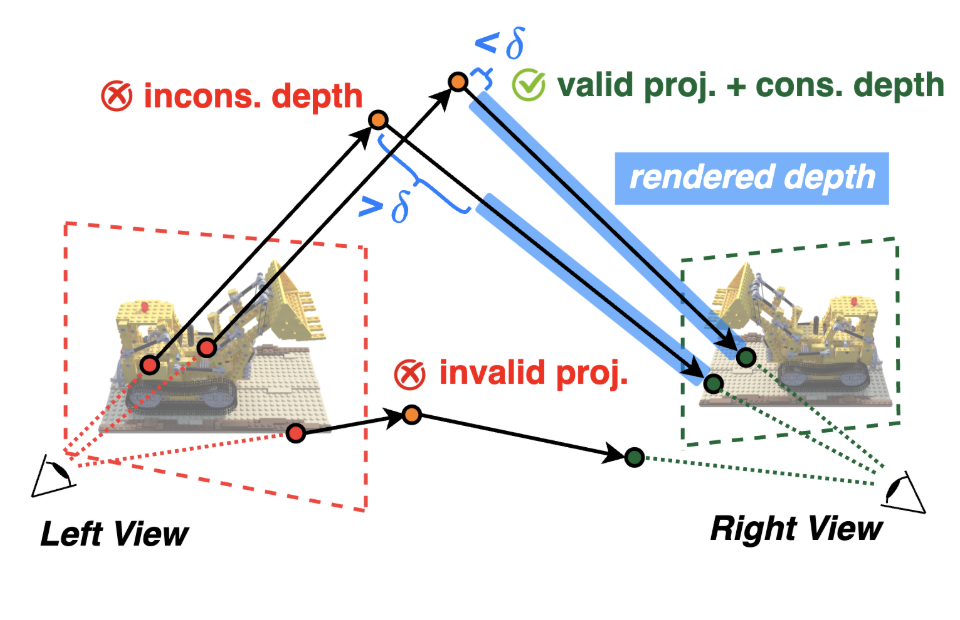
NeRD — 3D dataset distillation visualization
NeRD — projection-validity and depth-consistency pruning
2024 ISCA '24 · First author 3D ML

3D Dataset Distillation: Condensing 3D Datasets for Enhanced Data Efficiency in 3D Reconstruction.

Aishani Singh, Jason Zhang, Renyun Li, Yonggan Fu, Yingyan (Celine) Lin.

NeRD is a principled system for distilling 3D datasets while keeping the NeRF model fixed: it iteratively prunes redundant views using projection-validity and depth-consistency constraints to preserve independent spatial information. Across benchmarks, near-full reconstruction quality holds with as little as 40% of the original data — suggesting viewpoint diversity matters more than dataset size. Conducted at Georgia Tech's Efficient and Intelligent Computing Lab.

04. Beyond the Lab

Creative pursuits

Theatre performer and stage manager; former writer and editor for The Harker Aquila. Work in plays and journalism received Honorable Mention from the Alliance for Young Artists & Writers.

Reading & learning

Currently working through political theory, technology ethics, and contemporary history. Particularly interested in AI governance, accessibility, and digital rights.

Community

Previously interned with the California State Senate on accessibility and inclusive-housing policy (sample work). Committed to building technology that serves underrepresented communities.

05. What's Next?

Let's connect

I'm always interested in discussing research opportunities, collaborations, or simply connecting with others in the field. Don't hesitate to reach out.

Get In Touch